Settings
 Fast Delivery
 Free Shipping
 Incoterms
 Payment Types


 Marketplace Product

How to Simplify Bluetooth Low Energy Connectivity Using Tiny Drop-in Modules
Contributed By DigiKey's North American Editors
2025-12-10
Bluetooth (BT) and its Bluetooth Low Energy (BLE) enhancement have become key technologies for communication. They enable Internet of Things (IoT) devices to connect and transfer data wirelessly, ranging from text and audio to streaming video.
However, the design, implementation, and certification of a complete BT node require expertise in baseband analog and digital functions, firmware-driven embedded processing, and radio-frequency (RF) design of both the receiver's low-noise front-end amplifier and the transmitter's power amplifier.
These functions must also be supported by effective power management. Additionally, each BT node must meet a comprehensive list of objectives related to performance, as well as regulatory requirements regarding RF interference (RFI) and electromagnetic interference (EMI). These mandates can complicate design and slow device deployment.
This article provides a brief overview of BLE and its suitability for low-power IoT devices. It then introduces ready-to-use BLE modules from Ezurio and shows how they can help accelerate the development of BLE-enabled IoT nodes.
From Bluetooth to BLE
Bluetooth is an open global standard for wireless data and voice transfer, enabling low-cost, short-range wireless connectivity among various electronic devices. Operating in the 2.4 GHz industrial, scientific, and medical (ISM) band, its applications include limited-distance transmission of audio and text images, video streaming, smartphone-to-earbud pairing, and low-energy IoT connections.
The Bluetooth 1.0 specification called for a range of 10 m (for Class-2 devices), simple peer-to-peer networking, and a data rate of 732.2 kilobits per second (kbits/s); the first products were introduced in 2000. Enhancements in Versions 2.0 (2004) and 3.0 (2009) increased the data rates to 3 and 24 megabits per second (Mbits/s), respectively.
However, the power requirements for the original BT link were too high for many of the target applications. In 2010, Version 4.0 (BLE) was adopted, and prior versions were renamed informally as Bluetooth Classic (Figure 1). BLE decreased power by about 90% using an ultra-low-power idle mode based on an optimized low-bandwidth protocol stack tailored for IoT devices. This idle mode allows IoT sensors, location beacons, smart-home nodes, medical devices, and fitness trackers to run for years on a tiny coin-cell battery.
|
Figure 1: Shown is a summarized comparison of Bluetooth Classic (Versions 1.0 through 3.0) and BLE (Versions 4.0 through 6.0). (Image source: MOKOSmart)
Each version of BT allows designers to choose and balance tradeoffs in distance, data rate, and power. The latest version of BLE is 6.0 (2024), and it supports maximum data rates between 1 Mbits/s and 2 Mbits/s in lower-power mode, extended range, and peer-to-peer, star, broadcast, and mesh topologies.
BLE modules simplify design-in
Although BT is a versatile and suitable technology for shorter-range, lower-power wireless links, its actual implementation requires a blend of multiple components and technologies, spanning processor, memory, analog RF front-end, RF power amplifier, and antenna. Additionally, there is a software-driven data-link protocol and stack. The selection and design-in of these various elements can be challenging.
To simplify the design of BLE-enabled devices, Ezurio integrated the necessary elements in its BL54L15 BLE modules (Figure 2). At the core of these modules is Nordic Semiconductor’s nRF54L15 system on chip (SoC).
 Figure 2: The BL54L15 family of BLE modules comprises complete, highly integrated solutions that include all the necessary functions for a successful wireless implementation. (Image source: Ezurio)
Notable features of these modules include:
- Dual-core processing based on a 128 megahertz (MHz) Arm Cortex-M33 and a 128 MHz RISC-V coprocessor
- Large memory capacity comprising 1.5 megabytes (Mbytes) of non-volatile memory (NVM) and 256 kilobytes (Kbytes) of random access memory (RAM)
- Enhanced security
These modules provide secure and robust support for BLE and 802.15.4, offering flexible programming capabilities through the Nordic nRFConnect Software Development Kit (SDK), the Zephyr real-time operating system (RTOS), and the Ezurio Canvas Software Suite. Canvas enables MicroPython scripting capabilities, simplifying and speeding up application development. The overall configuration uses all of the nRF54L15 hardware features and capabilities.
The two BL54L15 modules are the 453-00001R (Figure 3, left), which features a pre-certified printed circuit board (pc board) trace antenna, and the 453-00044R (Figure 3, right) with an MHF4 connector to support an external antenna. Both modules operate from a 1.7 VDC to 3.5 VDC supply, and each is housed in a compact 14 mm × 10 mm × 1.6 mm package.
 Figure 3: The 453-00001R (left) has a pre-certified pc board trace antenna, while the 453-00044R (right) has an MHF4 connector to support an external antenna. (Image source: Ezurio)
The modules’ multiprotocol radio offers up to 7 decibels referenced to 1 milliwatt (dBm) transmit (TX) power (in 1 dB steps) and -94 dBm receiver (RX) sensitivity for a 1 Mbit/s throughput. The hardware is designed and certified for an industrial temperature range of -40°C to +105°C.
These modules also feature state-of-the-art security, supporting Secure Boot, Secure Firmware Update, and Secure Storage. Integrated tamper sensors detect physical attacks, while cryptographic accelerators are hardened against side-channel attacks. They also meet all relevant international standards and regulatory mandates for BLE performance and RFI/EMI emissions and susceptibility.
Accommodating an antenna
An antenna is a passive component that is critical to the BL54L15 modules’ function. Some designers prefer a surface-mount antenna for performance, positioning, package size, or cost reasons, while others prefer a pc board trace antenna. These preferences are why Ezurio offers two BL54L15 modules; however, designers need to be cautious when using them.
For example, the performance of the 453-00001R’s integrated pc board trace antenna is sensitive to the host pc board topology. It is critical to locate the 453-00001R on the edge of the host pc board to allow the antenna to radiate properly (Figure 4). This keep-out area is approximately 5 mm wide and 28.6 mm long, with a pc board dielectric (no copper) height of 1.57 mm underneath the 453-00001R module.
 Figure 4: The pc board trace-antenna keep-out area (outlined in red) for the 453-00001R module is critical to achieving optimal performance. (Image source: Ezurio)
Ezurio offers some critical suggestions when using this integrated pc board trace antenna with both plastic and metal enclosures:
- To avoid seriously compromising antenna tuning, the minimum safe distance for metals is 40 mm from the top/bottom, and 30 mm from the left and right.
- Metal that is close to the pc board trace monopole antenna (in any direction) will degrade the antenna’s performance. The amount of degradation is entirely system-dependent; designers will need to perform tests with their host application.
- Any metal closer than 20 mm to the keep-out area will begin to significantly degrade performance (S11, gain, radiation efficiency).
- Test the range with a mock-up or prototype of the product to assess the effects of enclosure height and material (whether metal or plastic), as well as the host pc board ground.
As an alternative to the 453-00001R, designers can choose the 453-00044R BL54L15 module with its MHF4 micro-coaxial connector. A suitable external antenna option includes the surface-mount EMF2449A1-10MH4L (Figure 5, left) (36 × 12 × 0.1 mm), which features a flexible pc board for curved, space-constrained housings. Another antenna option is the EBL2400A1-10MH4L (Figure 5, right) (44.45 mm × 12.7 mm × 0.81 mm). This antenna incorporates a ground plane into its resonator structure, eliminating the need for an additional ground plane to radiate efficiently.
 Figure 5: Among the available antenna options for the 453-00044R module are the EMF2449A1-10MH4L flexible circuit-board antenna (left) and the EBL2400A1-10MH4L antenna with an integral ground plane (right). (Image source: Ezurio)
In addition to BLE connectivity, the BL54L15 series supports Zigbee and NFC-A Tag.
Evaluation boards and software support
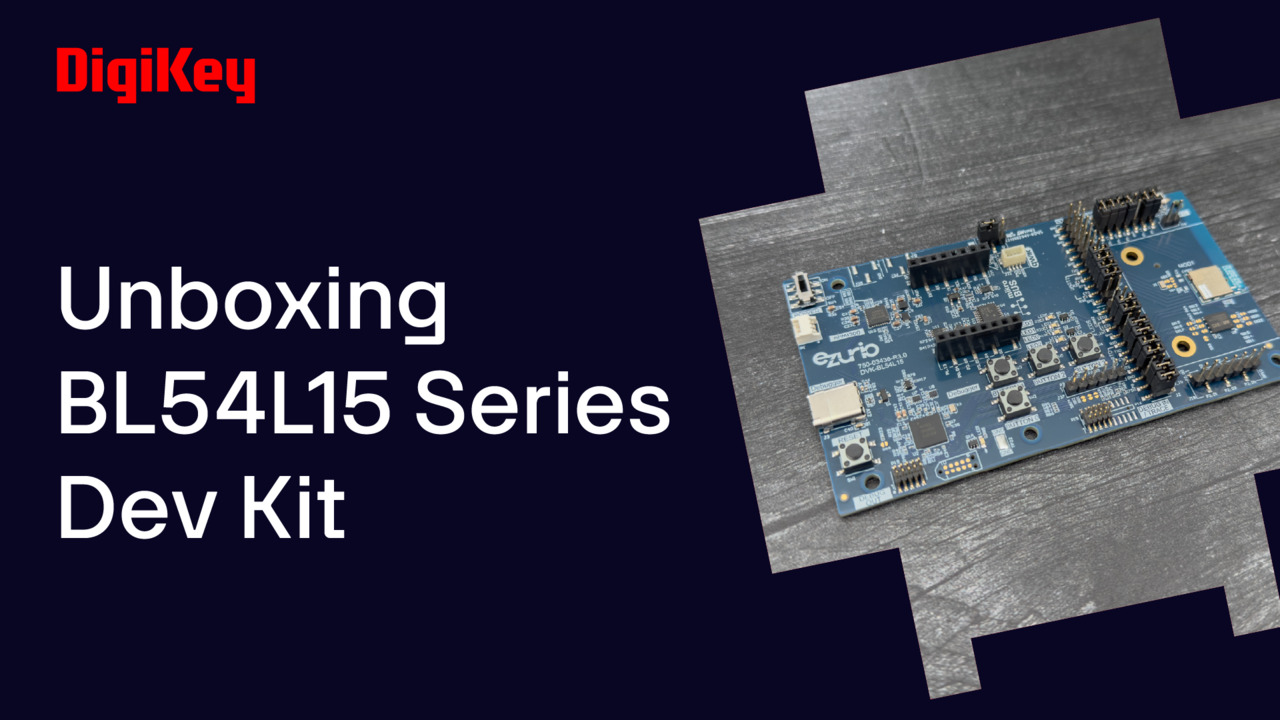
To accelerate the complete product-development cycle, Ezurio offers two evaluation boards. They are the 453-00001-K1 (Figure 6) for the 453-00001R with its integrated pc board trace antenna and the 453-00044-K1 for the 453-00044R with a surface-mount antenna.
 Figure 6: Shown is the 453-00001-K1 development board for the 453-00001R BLE module. (Image source: Ezurio)
Conclusion
BLE has become a crucial wireless standard and protocol for short-range, low-power connections. Ezurio offers designers compact BLE modules, evaluation boards, and software to quickly and effectively integrate BLE into end products.

Disclaimer: The opinions, beliefs, and viewpoints expressed by the various authors and/or forum participants on this website do not necessarily reflect the opinions, beliefs, and viewpoints of DigiKey or official policies of DigiKey.